12/12/2016

Memorias

At times, this journey has made me think of the seven months that I spent in Central America some years ago. My old blog still exists; I can hardly believe it's been nine years since I wrote about our life in Nicaragua, the hikes to the lagoon, the Granada Poetry Festival, and our trip to Miraflor.

When I wrote my final entry, remembering in a collection of photos everything I had seen in those seven months, I was already pregnant. Why, my son will turn eight in a few weeks.


11/12/2016

Polícia

Whether in Peru or Bolivia - the police is everywhere.


And they have tanks.


10/12/2016

Dos mundos

"That's something you'll see everywhere in Latin America", said my first Couchsurfing host in Cusco. "An upper-class neighbourhood can turn into a slum just from one street to another."

Often, however, the change is even more drastic: you see it from one house to another.


Coming from such a different culture with such different problems, it's difficult to understand the issues here. I can't tell if people are starving or how severe of a problem child labour is. I can't say whether poverty always means a dangerous neighbourhood, or whether a dangerous neighbourhood always means poverty. There are teenage street vendor girls with their sulky teenage faces glued to their smartphone screens, and middle-aged street vendor mothers with their three little children playing in the dirt next to their stands.

What I noticed already in Lima, however, is that it's as if there were two completely different economies existing side by side within the same city or the same country. That's possibly the case in Europe, too, but the differences are not quite that extreme.


Here, there's the first economy, where a person can buy a bagful of groceries from a supermarket for about 12 euros, take a city bus for some 40 cents and a taxi for perhaps 4 euros, go to a yoga class for 6 euros and buy a fresh fruit smoothie for 2 euros.

And then there's the other economy. For those people, taking a bus would be too expensive, so they walk. They buy their groceries from a market where they can choose the cheapest vegetables and haggle the prices down. They might have a fresh fruit smoothie when it's mango season and they walk past a tree that belongs to no-one. For those people, the other economy doesn't exist. The cable cars might float above their homes night and day, but they belong to another world beyond their reach.


Still, those people are not unemployed, or alcoholic, or homeless. They have jobs and they work long hours, and their children presumably go to school just like everybody else's. A bit of public education just isn't enough. The system we have in place works the same way here as it does everywhere: those who have some wealth tend to have it easier to gain more.

Those who have none have it much harder ever to gain any.


09/12/2016

Why I don't visit churches

I don't do cathedrals. 

For sure, they can be full of fantastic art and give us meaningful insight into the beliefs and ways of life of the past. That's all great. I might peek in one if I happen to stumble upon one and feel like some solemnity might be in order. But seriously, when you enter your fifth cathedral, do you still remember the first? When you've read the plate about the painter of the frescos, taken a picture of the altar and stepped back out into the sunshine, has any of it stuck with you?

I'm wary of museums, too. If I live in a place for a year, then, of course: I'll probably visit most of them. I'm profoundly interested in history, politics, art, design – all that stuff that museums are usually good at. But a museum run in the sense of a pub crawl is beyond the point. On this trip, as I've been constantly moving from place to place, I still haven't been inside one single museum.

You know, there are these guide books, "Lonely Planet" they are called, and they are awfully popular. You'll find them in the backpacks of almost every traveller in almost any hostel. At the tables of the hostel bar, the backpackers compare notes with each other and discuss which Lonely Planet recommended experience they have or haven't done yet.

One series of books the Lonely Planet Corporation has is called X on a Shoestring. It's for people for whom seeing a country or two isn't enough; they want to travel at least half a continent. Europe on a Shoestring. Southeast Asia on a Shoestring. The World on a Shoestring (coming up). The word shoestring is supposed to refer to cheap travel, but in my mind, it evokes an image of someone drawing a line from the main attraction to another onto a map with the help of a string and then sticking to it.

I used to own one of those books too, years back, and I know what great writers they have. All you have to do is to open one of them, any of them, and you'll feel like you're missing out on some great fun somewhere in the world. "Be sure not to miss the amazing experience of...", they'll write. "Ideally, you'll get to X the night before, do Y and Z, and then get up early the next morning to..."

And the readers do! They dash from rafting to horseback riding, from canopy tour to hot springs, from mountain biking to temple ruins, from bird-watching to swimming with the dolphins. And inside cities, from cathedrals to museums. Tick-tick-tick, they tick off to-do lists in their guidebooks, click-click-click, they snap the selfies with the temple ruin or the friendly dolphin, tap-tap-tap they post them for the world to see. At the end, they'll feel like they've seen everything there was in the country to see.

What I like to do is watch. I watch people, how they go about their life, what kind of work they do, where they go. I listen to the people on the streets and buses, see how they talk to their friends, partners, or strangers. I observe how mothers and fathers behave with their children, what children are allowed to do and what not, how the children play and how they talk to their parents. I look at what people eat and what they buy, what happens in situations of buying and selling, what kind of shops there are. 

I look at how people have decorated their houses or their yards. I watch celebrations of birthdays or other parties in the streets or in parks. I try to find places where I can hear people sing or see them dance. I go to places where local people go: bus stations, cinemas, educational institutions, vegetable markets. I visit parks and squares and observe how people spend their free time, and what kind of people seem to have free time. I look at how people laugh.

Whenever I get the chance, I talk with the locals and ask them questions, but I rarely approach complete strangers – as an intruding outsider, I feel I don't have the right. I like to remind myself that whenever I set my foot in some city, I'm stepping into other people's home, and none of that was made just so that I could have a great experience.

Before I arrive, or during the first days, I try to read or hear and understand as much of the local history as possible. After that, I just breathe in the way of life. There's so much of it, you don't have to worry about it running out anytime soon.


Cine


In La Paz, it's even harder to find anything vegetarian to eat on the street than in Peru. On the second day, after walking for hours and eating only biscuits, I give up and look up a veggie restaurant in town. This will save me from starvation.

While waiting for my meal, I chat with the two workers of the restaurant. The girl is from Chile and a little punk, but not too much. She's very cute. The guy, co-owner of the place, comes from Norwegian Lapland and looks like an elf. The girl who's a little punk but not too much says that there will be a free screening of a film at a cinema that evening. I ask the guy who looks like an elf why it is for free, and he just shrugs his shoulders: That happens sometimes. But it's in a neighbourhood I haven't been to yet, and since I had wanted to walk around there anyway, it sounds like a perfect plan.


On my way to the hostel, I stumble across a demonstration on the Plaza Mayor. A big demonstration. The people have filled the whole square, amongst them children, young and old people. It's not a very warm day, and everybody is wearing jumpers and jackets. Some have taken over the balcony of a building. Street vendors mingle among the crowd as usual.


Afraid of appearing blatantly ignorant of some hugely topical issue in the country (or being punched by some frenzied demonstrator), I choose not to ask anyone what the protest is all about. I try to read some of the banners, but they don't reveal the mystery either ("30 mega projects -> 30 disasters!"). Instead, I ask the kitchen worker of the hostel when I get back.


"Oh, it's about water", she says. "Water?" I enquire. She tells that there is a serious water shortage in the city and people are at the end of their rope. "And the government doesn't do anything", I suggest to empathise with the protestors, but she says it isn't really the government's fault. "You know, the water is gone", she smiles helplessly. "Climate change."

I spend the rest of the day roaming the streets of unknown neighbourhoods and find the cinema on time by 7:30. It turns out that the old beautiful building is actually a municipal theatre and the film to be shown is a work of some film students. Both the elf and the punk show up to accompany me, and once we have taken our seats, I ask the girl why she has left Chile. "Chile is terrible!" she exclaims. I'm surprised. What's so bad about Chile? "The people", she replies. "They're awful. I like Columbia, Bolivia and Paraguay."

Then there are four young men on the stage in suits, and the one holding the microphone is almost in tears, talking about the overwhelmingness of finally seeing their film being screened. But when the film – a drug mafia crime thriller – begins, it is so badly made (even for a student film) that we decide to leave half an hour into the start. I'm not disappointed, though. It's been a good La Paz day.


08/12/2016

Loco

I came to the city with no expectations, literally just because it happened to be on the way. And it blew me away – just with its insanity. La Paz is a crazy city.

First, for about the last hour or two before arriving, there is no road to speak of. There is just dirt and dust, and sometimes the bus I was in had to cross small rivers or flooded ditches, seemingly by driving right into them and hoping for the best. Swaying and sliding amongst the mud and stones, and began to realise why the bus was kind of small.


On the sides of the dirt paths were buildings that were all made of the same red tile and seemed to share something else too: it looked like nobody was living in them. In fact, the majority didn't even have a roof. Still they stood there, hundreds of them, for miles and miles. Sometimes we saw a few people walking on the street, signs of life amongst the calm ominosity. On the walls of some houses, adverts had been scribbled with big letters on white chalk, such as "ELECTRICIAN" followed by a telephone number.


After reaching the outskirts of the city, there is still a good half an hour's descend to the city itself. La Paz has been constructed in a canyon surrounded by several mountains. The highest of them is the snow-covered Illimani, which can be seen from most parts of the city.


As I had arrived without knowing anything of the place, I resorted to the Internet. I learned that the city was founded in the 16th century and is not particularly big with under one million inhabitants. With altitudes varying from 3200 to 4100 metres, La Paz is the highest capital in the world. This means that there is very little chance for a fire; the oxygen in the air is so scarce that the flame burns only feebly.

With a variety of elevations, an underground train would not perhaps make much sense. That's why the Paceños commute by...dashing through the air?! The public transport system of gondola lifts, Mi Teleférico, was opened only two years ago and is strikingly modern. There are three lines in operation at the moment, and at least four more have been planned.


It's no wonder one would look to the skies for a solution to the transport problem. When I take my Virgin La Paz Walk, I see that the old, narrow streets are so packed with cars and minibuses that none of them seems to be moving anywhere. There isn't much room for people either, with the sidewalks full of street vendors sitting next to their banana pile or standing in front of their food cart. The feeling of crammedness is overwhelming.

Still, I can't help liking the city. The buildings are of varying ages, filthy but beautiful. The feel of La Paz is perplexing. Contrary to what the ghost town and the dirt road just before the city made me expect, and despite the street vendors and chaotic streets, the people seem– – –well, more familiar to me. (I refuse to say 'European' or 'Western', although I acknowledge the facts: having grown up in the so-called Western world, that is what I feel familiar with.) It's hard to put one's finger on it, but when I look at people, it's easier for me to understand what they do.


There is a different kind of diversity compared to the other places I've seen on this journey. The first thing I notice is a music conservatory. There is a large, beautiful bus station building. There are Italian restaurants. Daycares. Girls with a side cut or a nose piercing, next to the old women in their traditional costumes and the q'ipirina on their back. A group of teenagers going to the cinema, a couple of students coming from the university. Even people who, despite belonging to a gender or sexual minority, appear not to be living in the closet.

And although there are seemingly no tourists in the areas I walk in, I realise people don't stare at me. I no longer stand out like a sore thumb, and it is a huge relief.


x

07/12/2016

Lago Titicaca y el camino a La Paz


My second long bus journey: 17 hours.


Puno, Peru

At a little past five in the morning I wake up as the bus arrives in the town of Puno. We're told we'll have to continue with another bus in about two hours. I succumb to the circumstances and get myself a map of sorts copied on a piece of paper. Then I realise that Lake Titicaca is just behind the bus station.


Titicaca is a lake situated at some 3,800 metres above sea level and is almost the size of Uusimaa (and could fit nine Berlins in it). As such, it is considered to be the highest navigable lake in the world.

It's beautiful. And dirty.


The air is still cool this early in the morning when I stroll along the shore of the lake. There are people on their morning jog. And dogs, always dogs.


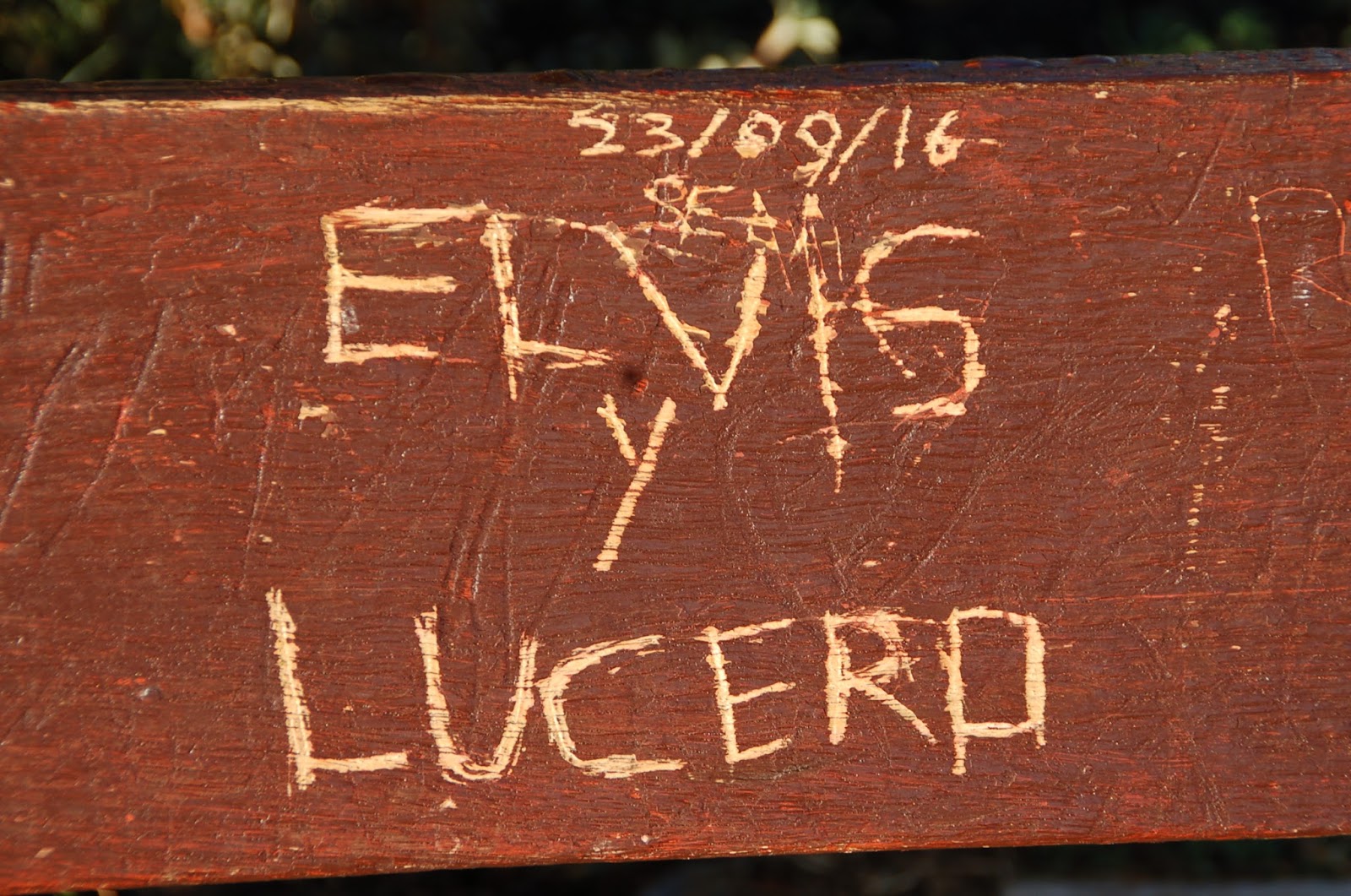
Elvis and Lucero, of the Titicaca Shore Bench, would like to send their greetings.


The contrasts are striking, as always.


I buy my breakfast - two rolls with avocado and salt - from the lady with a bike vending stand and get on the second bus.


After just a couple of hours down the road with the lake most of the time visible on our left, we arrive at the border. After a brief stop to have our passports stamped, we cross over to Bolivia. (The large white building is the Border Control office. The smaller one is a public bathroom.)


Cobacabana, Bolivia


In Cobacabana, we're once again told there will be a two-hour wait before the next bus. It's a happy surprise; now I'll have time to walk around Cobacabana too.


 Now, if you come on a horse from the nearby village to visit a friend in town, a part of you might find it smart to tie the horse somewhere while you're gone...but then again, why bother. (I watched the horse for a good half an hour, and while nobody came to look at it in that time, it didn't seem to bother or be bothered by anyone either.)


San Pedro de Tiquina, Bolivia

One more surprise for the day: we have to cross the lake. (Later, looking at the map I realise that the border runs in such a peculiar manner that crossing the lake is the only way to not end up in Peru again.) There are boats that have been especially constructed to carry buses. They are long and low and wooden, and quite unlike all the other ferry boats I've seen before.