Showing posts with label lima. Show all posts

14/12/2016

Compras, parte II


The people here like to cluster same kind of shops on the same street. I suppose it's wonderfully handy if you're a local: when the first hardware store doesn't have the kind of tool you're looking for, you just pop in at the next shop. When someone tells you of a new cake shop, "on the confectionery street", you'll have no problem finding it.

The hairdressers' street appears to include nail studios and tattoo artists as well.

For a visitor, however, it can be a nightmare. You're starving and wish to find one single restaurant, but all the street has to offer is barber shops. You've left your toothbrush in the last town and would simply like to clean your teeth for the first time in three days, but there is nothing but wallpaper everywhere. I've been lucky enough to also walk down a toilet bowl street and even a dentist's chair street. Or this - costumes and party deco street. (Parties and dressing up is important in these parts of the world.)

Be different: go for the barefooted Spiderman/Santa Claus costume next time.

And what about my bikini?

Well, I finally stumbled upon my luck, when I had already decided I would not look one street further. I was knackered, disappointed and angry. I had asked at several clothes shops, underwear shops and sports shops, and walked past hundreds of other businesses.

Then one saleswoman called me from a clothing store. It was one of those little shops inside a kind of a small market hall that consisted of just eight shops on both sides of a corridor. "What are you looking for, can I help?" she asked, and resigned, I answered, "You surely don't have bikinis, do you?"

"Of course we do!" she answered briskly. She was there with a friend, both of them in their fifties. The shop was perhaps six square metres and covered from the floor to the ceiling with clothes that looked like they were all about to fall from the shelves. Eagerly, the woman pulled a plastic bag from one of the shelves, and together with the friend, they started emptying its contents onto the counter.

There was a swimming suit and two sets of bikinis. No different colours, different models, not even different sizes. Just those three, take it or leave it. The women lifted the bikini tops to hold them over my chest; that was the amount of trying on there was to do. They concluded that the black one fit me perfectly.

I left the shop with a new black bikini in my bag.
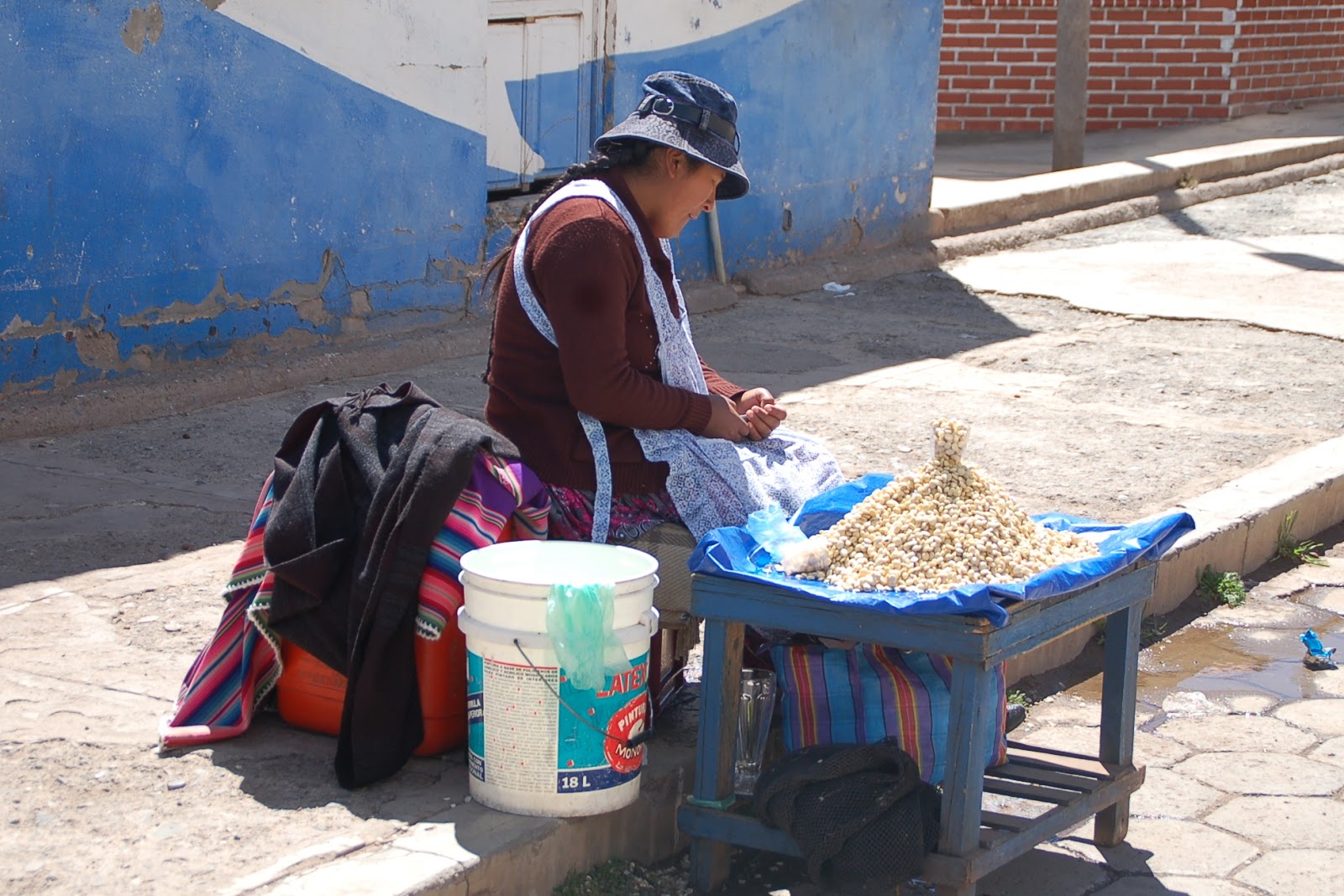


In general, I try as much as possible to avoid posting photos of people without their permission, unless they are in large groups and thus not that intimately portrayed. In this post, however, I felt like it would have been impossible to picture the topic without showing a couple of faces too.

13/12/2016

Compras, parte I


When travelling, one encounters a stunning number of surprising things. The people look different from those at home. They speak a strange language. The climate may be completely different and the weather might do unexpected things. The houses look probably different, the food tastes unlike anything you've tasted, and such everyday things as doing sports, using the bathroom or taking a bus may leave you at a loss.

But there's one thing that surely must be more or less the same everywhere: shopping! All over the world, people need groceries, toothpaste and underwear, right? Walk in the shop, make your pick, pay, done?

Haha. Ha.


Case Study Bikini:

I had arrived in Lima just a few days earlier, and I knew I was going to visit some hot springs near Machu Picchu in a couple of days. As my next destination, Cusco, was up on the mountains and nowhere near lakes or the sea, I figured I should try to find a swimming suit already in Lima, just to be sure.

Just to be sure! After having wondered around the streets for three hours, I gave up on the other thing on my To Buy List, a sleeping bag; I was exhausted and decided that in addition to sleeping without a mattress the next couple of nights, I would also have to sleep without any covers. But the bikini was more important. I was not going to miss out on the hot springs after hiking up and down mountain paths for two days.


Typically, I assume, people in Peru and Bolivia buy everything they need from tiny stores which are just a couple of shelves or even just one stand. The most common form of it is a street vendor's stand, and it can sell anything. That is, anything within a range. The problem is that what belongs to a range might not be that obvious for a foreigner.

There's the cosmetics stand, with hundreds if not thousands of little products arranged meticulously under one big umbrella - but if you're looking for toothpaste, you'll be met with just an apologetic (or disgusted) shake of a head. There's the underwear stand with its selection of simple white cotton knickers, plush red lacy underwear and the daring lean G string - but of course no swimwear. The bakery stand has all kinds of tempting-looking sweet goods but definitely no bread. And so on.


Even when things are not sold on the streets, the indoor stores are hardly any bigger. They come mostly in a cluster of little shops, much like a market hall, but so tiny that the salesperson barely has room for that one chair that he or she sits on. They can sell fruit, or hardware, or mobile phone parts, anything. Just that the range is always very restricted. Services are possible too: I've seen several shoe repair shops that have made me take another look in astonishment, as it seems that no one can repair anything is such a confined space.

In Lima, and even more in La Paz, I also saw some more Western-style shops, with enough room for the customers to walk in and look at things. Presumably they are there just for the tourists and the richest of the rich, though. And even though I browsed through those, too, on my bikini-searching quest,  I didn't find one - or then they had a selection of just two models in horrid eighties' Hawaii-style colours and patterns.

(to be continued!)

10/12/2016

Dos mundos

"That's something you'll see everywhere in Latin America", said my first Couchsurfing host in Cusco. "An upper-class neighbourhood can turn into a slum just from one street to another."

Often, however, the change is even more drastic: you see it from one house to another.


Coming from such a different culture with such different problems, it's difficult to understand the issues here. I can't tell if people are starving or how severe of a problem child labour is. I can't say whether poverty always means a dangerous neighbourhood, or whether a dangerous neighbourhood always means poverty. There are teenage street vendor girls with their sulky teenage faces glued to their smartphone screens, and middle-aged street vendor mothers with their three little children playing in the dirt next to their stands.

What I noticed already in Lima, however, is that it's as if there were two completely different economies existing side by side within the same city or the same country. That's possibly the case in Europe, too, but the differences are not quite that extreme.


Here, there's the first economy, where a person can buy a bagful of groceries from a supermarket for about 12 euros, take a city bus for some 40 cents and a taxi for perhaps 4 euros, go to a yoga class for 6 euros and buy a fresh fruit smoothie for 2 euros.

And then there's the other economy. For those people, taking a bus would be too expensive, so they walk. They buy their groceries from a market where they can choose the cheapest vegetables and haggle the prices down. They might have a fresh fruit smoothie when it's mango season and they walk past a tree that belongs to no-one. For those people, the other economy doesn't exist. The cable cars might float above their homes night and day, but they belong to another world beyond their reach.


Still, those people are not unemployed, or alcoholic, or homeless. They have jobs and they work long hours, and their children presumably go to school just like everybody else's. A bit of public education just isn't enough. The system we have in place works the same way here as it does everywhere: those who have some wealth tend to have it easier to gain more.

Those who have none have it much harder ever to gain any.


18/11/2016

Adiós

I will be leaving Lima and heading to the Andes.

The city of Cusco is situated some 1,000 kilometres from Lima at an altitude of 3,400 metres. The bus trip will take 22 hours.

Goodbye, ocean!


(Although I must admit that I am more of a lake than sea person. I suppose you could say my attitude towards the ocean is similar to how I see cats: I can admire and be inspired by them, but I will never be able to feel a true connection. Then again, I always fall in love with cat/sea people.)

Impresiones del Centro Hístorico


The Centro Histórico of Lima is not the neighbourhood where most tourists stay; that is Miraflores on the shore some six kilometres from the historical centre.

The centre has a central square similar to many other old colonial cities, but because of regular earthquakes and fires in the past, the buildings are not actually particularly old.


17/11/2016

¡Qué sorpresa!

Quite spontaneously and against my usual Facebook ban, I posted my location as soon as I had arrived in Lima. I could not have imagined who would answer me.

Three years ago, we hosted a lovely young French man named Benjamin in our home in Berlin. He came to us through Couchsurfing and ended up staying for more than two weeks while attending a course in Kreuzberg. While he lived with us, the older one of our two children turned five, and Benjamin crafted an amazing airplane for him mostly out of used toilet rolls and tape. He's always been specially remembered in our home, although we never had a chance to meet again.

-Hola Tui, yo también estoy en Lima! Ben now wrote under my FB post. I had to read it a couple of times to believe my eyes.

Benjamin had come just a week before me. Together with his Peruvian wife and their little son they had just made the decision to move from France to Peru.


And so it just happens that I'm staying with them in the Surco district for my last two nights in Lima!

16/11/2016

Transporte público


Taking buses, apart from long aimless walks, have been my favourite pastime in Lima.

The buses are big vans fitted with small, cushy and mostly torn seats. On the side of the van are written some names of places where the bus is going to, in some areas even a route number, but  most importantly, there is a person standing in the open doorway and shouting on top of his or her lungs the bus's route to potential passengers.

Taking a bus, or a combi as it's called, is not particularly difficult, as they stop practically everywhere. I later realised there are actual bus stops as well, but mostly the buses stop at traffic lights or where ever the door stander's radar detects a passenger wanting to get on. The traffic police on the side of the road might try to get the combis to move on by shouting at them while the angry drivers behind the bus attempt the same by honking their horns – but both seems to have suffered somewhat of an inflation.


If you can't get to a forest, get a forest onto your balcony...?


Once in the bus, the door stander collects your money, sometimes right away, sometimes later and other times only when you get off. A trip for about 30 minutes costs 1 sol, which is under €0.30. Sometimes there is a printed price list on the window, but so far that hasn't seemed to correspond to anything.

Then you just sit back and enjoy the trip! And, well, hope that the bus is going to where you want to go. And that you know where to get off.


15/11/2016

Ciudad de los Reyes


Lima is divided into 43 districts, of which 30 are considered the City of Lima. Each district is huge, with 200,000–400,000 inhabitants.  That means there are actually 30 different Limas, each with their own centres, characteristics, and levels of cleanliness and security. The everyday life happens within one's own district; people are not necessarily familiar with the other areas. The population of the whole city is almost eight million.


What is common to all the different neighbourhoods is that the buildings are low, mostly two or three storeys high. Only near the Pacific shore are there luxurious high-risers. The whole city looks like it's grown on its own account, spreading in different directions, with buildings of varying height and width having been built in a haphazard manner where ever there was space.


The only planning that seems to have gone into how to city is structured is the planning for cars. Everywhere, the neighbourhoods are cut with massive, noisy avenues with six or more lanes. It's still not enough: all the lanes are always full of cars, the air filled with exhaust smoke and the sound of constant honking of the horns. In the midst of all this there are people, stepping in an out of small buses, doing their shopping at the fruit stands in the corners, going on about their life.

"Excessive playing causes gambling addiction" – but to me, ludopatía first sounded like something even more horrendous...!

Looking from afar, the buildings spreading into the horizon resemble sinister, square creatures with ghost-like eyes. It's  because the windows are mostly darkened and thus often look like there are no window panes, only holes. Only after looking closer in some poorer areas I realised that some of them indeed have no glass.


The colour of Lima is dirty white. It's not just the buildings that are mostly some shade of white; it's also that the sky is overcast much of the time. The climate of Lima is pleasant – it's usually between 20 and 26 degrees Celsius – but the sky is often covered with clouds. The pollution must have something to do with it, but I was also given another explanation: The bordering sea is so cold that, hitting the warm air of Lima, it always creates new clouds.