Showing posts with label city. Show all posts

21/12/2016

Playa de los Hippies

The family has promised to take me to the town of Jujuy, but to our dismay the car won't start, and after trying for a while to get the engine going by pushing, I have to give up and start a three-kilometre run to catch the bus that only runs once every day.

After an hour and a half of standing in an old rackety bus that anyone would have considered full already before the last twenty people got in, I'm finally at the bus station in Jujuy. It's almost 8 pm, and I find there is a night bus to Cordoba, 900 kilometres away, leaving in an hour. I decide to take that instead of making my way straight to Buenos Aires; I can still spend a day or two in Cordoba before reaching my final destination.


Cordoba is a university town, full of colonial and Jesuit history. I walk around the streets and visit a museum on the "disappeared" people in Argentina in the 1970s, but I'm mostly enthusiastic about the prospect of going to one of the riverside beaches outside Cordoba.

On my second day, I catch a bus that takes me one and a half hours outside the town - but I'm late. It's already early evening when I get there, and I also don't have precise directions. I ask a girl in the bus, and luckily she and the three guys she's with are going to the same beach I'm looking for: La Playa de los Hippies.

Although it's embarrassing how hard it is for me to understand their Argentinian accent, I'm still happy to be with them, since it turns out the route is not that straightforward. After getting out of the bus in the middle of nowhere, you first have to walk, then call a kind of a taxi, and after the taxi trip either pay for a canoe ride or walk over a hill for twenty minutes. As I haven't been aware of all these extra expenses, I haven't brought enough money with me, and have no chance but to hope I will find the right path over the hill. I say goodbye to the girl and her friends, who sit down to wait for the canoe.


But the Playa itself is lovely. Indeed, it is a Hippie Beach, with tents and more permanent makeshift living constructions all around the shore, but it's all very peaceful. I'm almost the only person in the water. I float in the  river and let the mild current carry me while the sun sets behind the hills.

When I begin my long walk back to where the bus left us, the moon has already risen to guide my path.


14/12/2016

Compras, parte II


The people here like to cluster same kind of shops on the same street. I suppose it's wonderfully handy if you're a local: when the first hardware store doesn't have the kind of tool you're looking for, you just pop in at the next shop. When someone tells you of a new cake shop, "on the confectionery street", you'll have no problem finding it.

The hairdressers' street appears to include nail studios and tattoo artists as well.

For a visitor, however, it can be a nightmare. You're starving and wish to find one single restaurant, but all the street has to offer is barber shops. You've left your toothbrush in the last town and would simply like to clean your teeth for the first time in three days, but there is nothing but wallpaper everywhere. I've been lucky enough to also walk down a toilet bowl street and even a dentist's chair street. Or this - costumes and party deco street. (Parties and dressing up is important in these parts of the world.)

Be different: go for the barefooted Spiderman/Santa Claus costume next time.

And what about my bikini?

Well, I finally stumbled upon my luck, when I had already decided I would not look one street further. I was knackered, disappointed and angry. I had asked at several clothes shops, underwear shops and sports shops, and walked past hundreds of other businesses.

Then one saleswoman called me from a clothing store. It was one of those little shops inside a kind of a small market hall that consisted of just eight shops on both sides of a corridor. "What are you looking for, can I help?" she asked, and resigned, I answered, "You surely don't have bikinis, do you?"

"Of course we do!" she answered briskly. She was there with a friend, both of them in their fifties. The shop was perhaps six square metres and covered from the floor to the ceiling with clothes that looked like they were all about to fall from the shelves. Eagerly, the woman pulled a plastic bag from one of the shelves, and together with the friend, they started emptying its contents onto the counter.

There was a swimming suit and two sets of bikinis. No different colours, different models, not even different sizes. Just those three, take it or leave it. The women lifted the bikini tops to hold them over my chest; that was the amount of trying on there was to do. They concluded that the black one fit me perfectly.

I left the shop with a new black bikini in my bag.


In general, I try as much as possible to avoid posting photos of people without their permission, unless they are in large groups and thus not that intimately portrayed. In this post, however, I felt like it would have been impossible to picture the topic without showing a couple of faces too.

13/12/2016

Compras, parte I


When travelling, one encounters a stunning number of surprising things. The people look different from those at home. They speak a strange language. The climate may be completely different and the weather might do unexpected things. The houses look probably different, the food tastes unlike anything you've tasted, and such everyday things as doing sports, using the bathroom or taking a bus may leave you at a loss.

But there's one thing that surely must be more or less the same everywhere: shopping! All over the world, people need groceries, toothpaste and underwear, right? Walk in the shop, make your pick, pay, done?

Haha. Ha.


Case Study Bikini:

I had arrived in Lima just a few days earlier, and I knew I was going to visit some hot springs near Machu Picchu in a couple of days. As my next destination, Cusco, was up on the mountains and nowhere near lakes or the sea, I figured I should try to find a swimming suit already in Lima, just to be sure.

Just to be sure! After having wondered around the streets for three hours, I gave up on the other thing on my To Buy List, a sleeping bag; I was exhausted and decided that in addition to sleeping without a mattress the next couple of nights, I would also have to sleep without any covers. But the bikini was more important. I was not going to miss out on the hot springs after hiking up and down mountain paths for two days.


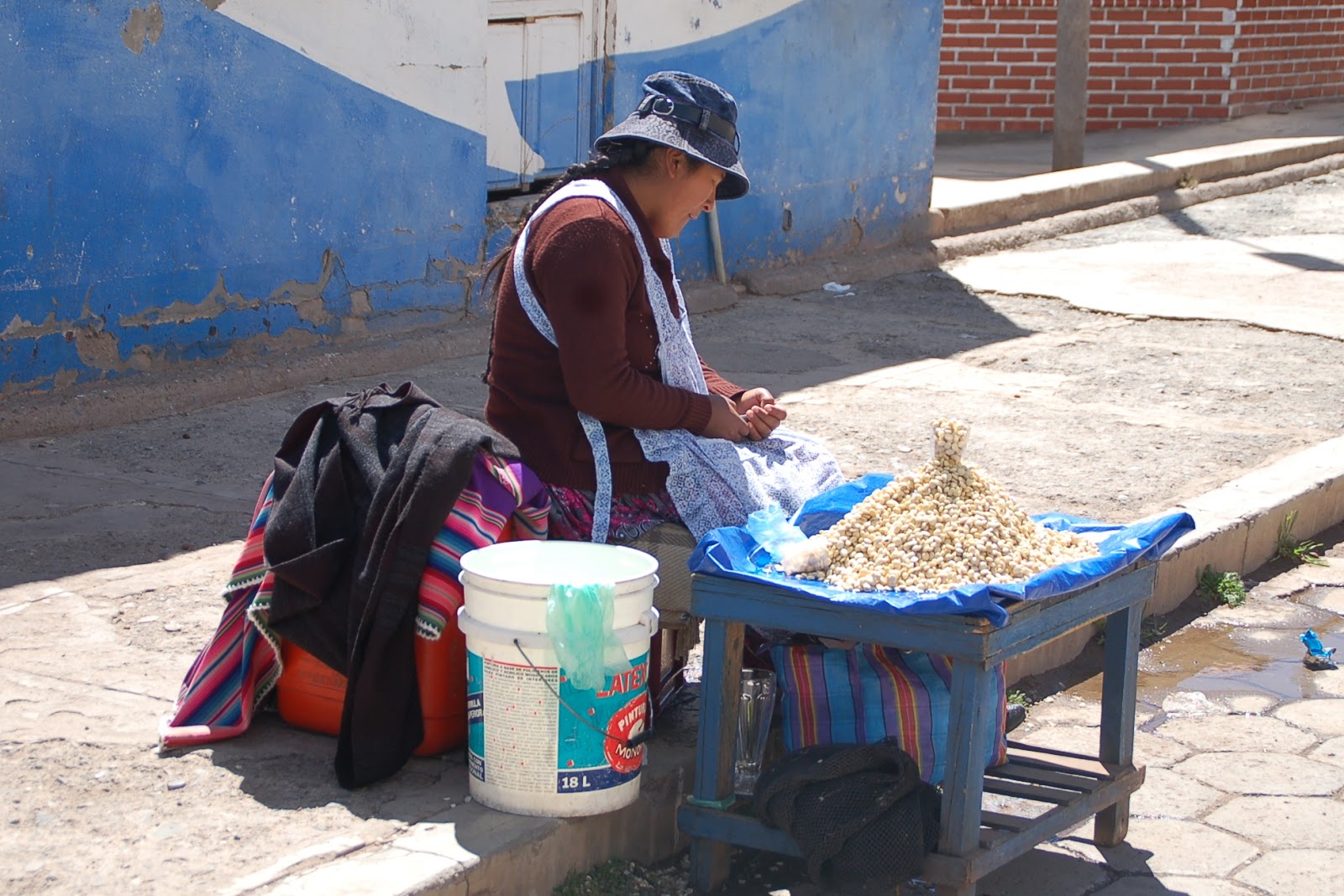
Typically, I assume, people in Peru and Bolivia buy everything they need from tiny stores which are just a couple of shelves or even just one stand. The most common form of it is a street vendor's stand, and it can sell anything. That is, anything within a range. The problem is that what belongs to a range might not be that obvious for a foreigner.

There's the cosmetics stand, with hundreds if not thousands of little products arranged meticulously under one big umbrella - but if you're looking for toothpaste, you'll be met with just an apologetic (or disgusted) shake of a head. There's the underwear stand with its selection of simple white cotton knickers, plush red lacy underwear and the daring lean G string - but of course no swimwear. The bakery stand has all kinds of tempting-looking sweet goods but definitely no bread. And so on.


Even when things are not sold on the streets, the indoor stores are hardly any bigger. They come mostly in a cluster of little shops, much like a market hall, but so tiny that the salesperson barely has room for that one chair that he or she sits on. They can sell fruit, or hardware, or mobile phone parts, anything. Just that the range is always very restricted. Services are possible too: I've seen several shoe repair shops that have made me take another look in astonishment, as it seems that no one can repair anything is such a confined space.

In Lima, and even more in La Paz, I also saw some more Western-style shops, with enough room for the customers to walk in and look at things. Presumably they are there just for the tourists and the richest of the rich, though. And even though I browsed through those, too, on my bikini-searching quest,  I didn't find one - or then they had a selection of just two models in horrid eighties' Hawaii-style colours and patterns.

(to be continued!)

11/12/2016

Polícia

Whether in Peru or Bolivia - the police is everywhere.


And they have tanks.


09/12/2016

Why I don't visit churches

I don't do cathedrals. 

For sure, they can be full of fantastic art and give us meaningful insight into the beliefs and ways of life of the past. That's all great. I might peek in one if I happen to stumble upon one and feel like some solemnity might be in order. But seriously, when you enter your fifth cathedral, do you still remember the first? When you've read the plate about the painter of the frescos, taken a picture of the altar and stepped back out into the sunshine, has any of it stuck with you?

I'm wary of museums, too. If I live in a place for a year, then, of course: I'll probably visit most of them. I'm profoundly interested in history, politics, art, design – all that stuff that museums are usually good at. But a museum run in the sense of a pub crawl is beyond the point. On this trip, as I've been constantly moving from place to place, I still haven't been inside one single museum.

You know, there are these guide books, "Lonely Planet" they are called, and they are awfully popular. You'll find them in the backpacks of almost every traveller in almost any hostel. At the tables of the hostel bar, the backpackers compare notes with each other and discuss which Lonely Planet recommended experience they have or haven't done yet.

One series of books the Lonely Planet Corporation has is called X on a Shoestring. It's for people for whom seeing a country or two isn't enough; they want to travel at least half a continent. Europe on a Shoestring. Southeast Asia on a Shoestring. The World on a Shoestring (coming up). The word shoestring is supposed to refer to cheap travel, but in my mind, it evokes an image of someone drawing a line from the main attraction to another onto a map with the help of a string and then sticking to it.

I used to own one of those books too, years back, and I know what great writers they have. All you have to do is to open one of them, any of them, and you'll feel like you're missing out on some great fun somewhere in the world. "Be sure not to miss the amazing experience of...", they'll write. "Ideally, you'll get to X the night before, do Y and Z, and then get up early the next morning to..."

And the readers do! They dash from rafting to horseback riding, from canopy tour to hot springs, from mountain biking to temple ruins, from bird-watching to swimming with the dolphins. And inside cities, from cathedrals to museums. Tick-tick-tick, they tick off to-do lists in their guidebooks, click-click-click, they snap the selfies with the temple ruin or the friendly dolphin, tap-tap-tap they post them for the world to see. At the end, they'll feel like they've seen everything there was in the country to see.

What I like to do is watch. I watch people, how they go about their life, what kind of work they do, where they go. I listen to the people on the streets and buses, see how they talk to their friends, partners, or strangers. I observe how mothers and fathers behave with their children, what children are allowed to do and what not, how the children play and how they talk to their parents. I look at what people eat and what they buy, what happens in situations of buying and selling, what kind of shops there are. 

I look at how people have decorated their houses or their yards. I watch celebrations of birthdays or other parties in the streets or in parks. I try to find places where I can hear people sing or see them dance. I go to places where local people go: bus stations, cinemas, educational institutions, vegetable markets. I visit parks and squares and observe how people spend their free time, and what kind of people seem to have free time. I look at how people laugh.

Whenever I get the chance, I talk with the locals and ask them questions, but I rarely approach complete strangers – as an intruding outsider, I feel I don't have the right. I like to remind myself that whenever I set my foot in some city, I'm stepping into other people's home, and none of that was made just so that I could have a great experience.

Before I arrive, or during the first days, I try to read or hear and understand as much of the local history as possible. After that, I just breathe in the way of life. There's so much of it, you don't have to worry about it running out anytime soon.


Cine


In La Paz, it's even harder to find anything vegetarian to eat on the street than in Peru. On the second day, after walking for hours and eating only biscuits, I give up and look up a veggie restaurant in town. This will save me from starvation.

While waiting for my meal, I chat with the two workers of the restaurant. The girl is from Chile and a little punk, but not too much. She's very cute. The guy, co-owner of the place, comes from Norwegian Lapland and looks like an elf. The girl who's a little punk but not too much says that there will be a free screening of a film at a cinema that evening. I ask the guy who looks like an elf why it is for free, and he just shrugs his shoulders: That happens sometimes. But it's in a neighbourhood I haven't been to yet, and since I had wanted to walk around there anyway, it sounds like a perfect plan.


On my way to the hostel, I stumble across a demonstration on the Plaza Mayor. A big demonstration. The people have filled the whole square, amongst them children, young and old people. It's not a very warm day, and everybody is wearing jumpers and jackets. Some have taken over the balcony of a building. Street vendors mingle among the crowd as usual.


Afraid of appearing blatantly ignorant of some hugely topical issue in the country (or being punched by some frenzied demonstrator), I choose not to ask anyone what the protest is all about. I try to read some of the banners, but they don't reveal the mystery either ("30 mega projects -> 30 disasters!"). Instead, I ask the kitchen worker of the hostel when I get back.


"Oh, it's about water", she says. "Water?" I enquire. She tells that there is a serious water shortage in the city and people are at the end of their rope. "And the government doesn't do anything", I suggest to empathise with the protestors, but she says it isn't really the government's fault. "You know, the water is gone", she smiles helplessly. "Climate change."

I spend the rest of the day roaming the streets of unknown neighbourhoods and find the cinema on time by 7:30. It turns out that the old beautiful building is actually a municipal theatre and the film to be shown is a work of some film students. Both the elf and the punk show up to accompany me, and once we have taken our seats, I ask the girl why she has left Chile. "Chile is terrible!" she exclaims. I'm surprised. What's so bad about Chile? "The people", she replies. "They're awful. I like Columbia, Bolivia and Paraguay."

Then there are four young men on the stage in suits, and the one holding the microphone is almost in tears, talking about the overwhelmingness of finally seeing their film being screened. But when the film – a drug mafia crime thriller – begins, it is so badly made (even for a student film) that we decide to leave half an hour into the start. I'm not disappointed, though. It's been a good La Paz day.


29/11/2016

Cusco


Cusco is a UNESCO World Heritage Site and the "Historical Capital of Peru", hosting nearly two million visitors a year.

And it shows.

Tourism appears to concentrate on the Main Square, Plaza de Armas, the streets surrounding it, and the historical San Blas area situated on the hillside just above Plaza de Armas. I assume most of the city's 400,000 inhabitants can live their lives quite undisturbed by the tourist masses, as the city stretches far and wide with most buildings having just two or three floors.


However, my first Couchsurfing host lived right in the middle of San Blas, which I was excited about at the beginning, as it was supposed to be the best area to be in. And true, the narrow streets were very picturesque, and I loved the Quechuan street names and ancient white stone buildings that originate from the times before the Spanish conquerors had set their foot in the country.


If there only had been anything else left from times past. But no; this was a real tourist heaven. Or hell, depending on how you care to see it. Yoga, reiki, massages; hand-made scarfs, handicrafts, lama wool, alpaca; organised tours to do Machu Picchu, to do drugs with a shaman, to do paragliding or liquor tasting, to do a real Peruvian (I wouldn't be surprised); hostels with a bar, hostels with a view, hostels with oh-so-quaint colourful deco; vegan food vegan food VEGAN FOOD!!


Every place had a beautiful, hearty hippie name such as Mother Earth or Sister Moon or Universal Balance – or then "Inka" anything. In Spanish of course, to be cooler. And while I love yoga and vegan food and am fully aware of the complexity of foreigners travelling somewhere and demanding to get the really truly authentic experience (or, perhaps worse still, being horrified that a lot of other travellers want to see the same place as you), I could not take it.


It didn't make me sad because of the locals who were the owners of those businesses; I understand they have to earn their living and sell what people buy. (An important question, though, is whether those places are even owned by locals.) But it made me sad because of the vast masses of people who fly to Cusco and buy a reiki-shaman beer tour with a view and find it lovely. That's what I find so disturbing.


15/11/2016

Ciudad de los Reyes


Lima is divided into 43 districts, of which 30 are considered the City of Lima. Each district is huge, with 200,000–400,000 inhabitants.  That means there are actually 30 different Limas, each with their own centres, characteristics, and levels of cleanliness and security. The everyday life happens within one's own district; people are not necessarily familiar with the other areas. The population of the whole city is almost eight million.


What is common to all the different neighbourhoods is that the buildings are low, mostly two or three storeys high. Only near the Pacific shore are there luxurious high-risers. The whole city looks like it's grown on its own account, spreading in different directions, with buildings of varying height and width having been built in a haphazard manner where ever there was space.


The only planning that seems to have gone into how to city is structured is the planning for cars. Everywhere, the neighbourhoods are cut with massive, noisy avenues with six or more lanes. It's still not enough: all the lanes are always full of cars, the air filled with exhaust smoke and the sound of constant honking of the horns. In the midst of all this there are people, stepping in an out of small buses, doing their shopping at the fruit stands in the corners, going on about their life.

"Excessive playing causes gambling addiction" – but to me, ludopatía first sounded like something even more horrendous...!

Looking from afar, the buildings spreading into the horizon resemble sinister, square creatures with ghost-like eyes. It's  because the windows are mostly darkened and thus often look like there are no window panes, only holes. Only after looking closer in some poorer areas I realised that some of them indeed have no glass.


The colour of Lima is dirty white. It's not just the buildings that are mostly some shade of white; it's also that the sky is overcast much of the time. The climate of Lima is pleasant – it's usually between 20 and 26 degrees Celsius – but the sky is often covered with clouds. The pollution must have something to do with it, but I was also given another explanation: The bordering sea is so cold that, hitting the warm air of Lima, it always creates new clouds.