05/12/2016

Las raíces


I walk behind a woman up the stone steps of the Choquechaka street. On her head she has the typical thick, wide-brimmed brown hat. Below the hat, two long braids come far down on her back and have been tied together at the end. She's wearing a thick jumper, an apron, a wide skirt  I'm assuming it's many skirts over on another  tights and a pair of simple shoes. In the mornings it can be very cold and the attire seems reasonable, but now, in the scorching late-afternoon air, I can't help being puzzled at the long sleeves and thick layers.

Over her body she's tied a large, square cloth. It's an aguayo, or a q'ipirina, and has a very colourful pattern. It's tied at the front with just a simple double knot, and inside it, on her back, she's carrying something sizeable and heavy. It could be fruit to sell, it could be vegetables to take home, it could be a baby; I can't see inside. Then I see the bundle wiggle a little. It must be a baby, tucked diagonally sideways into the warm safety of the cloth.

Or another woman, somewhat older: wearing jeans and a worn denim cap, but carrying her two-year-old in the same colourful q'ipirina, tied the same way with a knot at the front. The toddler's not hidden though, but sitting up, and is being stroked by the woman's older daughter who's walking at her side. One day, when the girl has her first child, she won't think twice about slipping her newborn inside the cloth and going on about her day.

Like it has been done here for thousands of years.


Walking always higher up on the narrow streets and slowly leaving the hustle of the city behind, I feel oddly rootless. I can understand how the people here have a stronger sense of identity, much like the Sami people in my own country. Here, history of the forefathers seems to be whispering its tales of various times from all sides.

The buildings in their entirety are some hundreds of years old at the longest, but their foundations have existed quite a lot longer. The large stones that form the first layer of the walls are ancient. I look at a white wall and try to see through it: what kind of a family sat here having breakfast a a hundred generations ago? What were their fears, their wishes, their songs? What kind of things did they keep secret from others?

Besides rootless, I feel oddly responsible for the Spanish Conquest over four hundred years ago. What would stand here now, had we Europeans been less greedy and selfish? Yet, it's staggering to see how much of the old customs, language and culture are still alive in the everyday life of the Andean people, despite the fact that they have begun to receive any governmental support only in the last decades. In the Cusco region, more than half of the people learn Quechua as their mother tongue. The religions of Christianity and Pachamama live side by side and overlap. Where else in the world has a subjugated culture been able to stick to their roots even that much?


I pass the last houses, walk through a small forest and across a field and arrive at what are nowadays called the Temple of the Monkey and the Temple of the Moon. No one can say for sure what they were originally called, for these places stem from times even before the Incas. There is not too much left of them; only a disorderly-looking collection of vast stones, and some caves that have been closed from the public. Still, it's possible to discern some things, such as the figures of important animals that have been carved into the crude stones. The sun is setting when I climb to the top of the Temple of the Moon and kneel down next to a specially shaped stone. It's carved on both sides into the shape of two steps, and it's what was used to tell the time a very long time ago.

I lay my hand on the stone and reach out to those people hundreds or thousands of years before this moment. Someone has touched the stone then just like I am now. Someone has been where I am, and has seen the last rays of sun disappear behind the mountains just like now.

So short is human life; so few sunrises and sunsets behind the mountains; so much we forget, so much is lost.

And the stone stands.


04/12/2016

Thank you, Machu Picchu


They're called sand flies/fleas. 
Some say they may live under your skin for weeks. 

03/12/2016

Buen provecho


For a vegetarian, Peru is unfortunately not a culinary paradise: all the traditional dishes consist of mostly meat or at least a lot of egg and milk. I don't eat that much in restaurants anyway while travelling, but of course it's always interesting to try some of the local delicacies.


Cooking just for myself is rather dull as well (and weird, after cooking for years for at least four people). I really haven't been able to conjure up much inspiration and have lived off pretty much the same dish throughout this journey. Its main ingredients are quinoa and avocado, two yummy and super healthy things that are quite unecological (and in some cases, unethical) when bought in Europe. But here I can eat them as much as I desire!

To prepare the daily meal: Cook quinoa, slice a whole ripe avocado, and cover it all with a big green salad, coriander and lime juice. Repeat ad infinitum.
(This version has a little fancier look to it as it was made for a host.)

To be honest though, I have not felt like eating much for weeks. I haven't had much appetite ever since I arrived in Lima, but I feel like the altitude sickness might have made it even worse. On many days I have eaten only a little fruit, which luckily is available in abundance. The markets and street vendors offer a plentiful selection of fresh vegetables, herbs, fruit and nuts. I've made sure to eat at least one chirimoya, the little sister of guanábana, per day.

Chirimoya, tumbo, tuna and pepino.


02/12/2016

Salineras


After having felt, at times, horribly lonely and out of place in the midst of (other) young Gringo Trail backpackers during my group trip to Machu Picchu, I was immensely grateful for one Couchsurfing gentleman named Kris* to accept me in his home despite his worries of it being too small to host anyone. Indeed it was tiny: the room pictured below worked both as his atelier and a kitchen, and behind it, there was just a small windowless bedroom. The roof leaked, there were no windows to look out of, and after a few days I noticed that even the walls were kind of make-shift structures. But none of that mattered; it was a lovely flat and I spent some happy last days in Cusco before leaving Peru.


Kris told me of some salt works that are located about two hours away from Cusco and suggested we could do a day trip there as he had also never been. I had no idea what to expect but was eager to go. We first spent some time in the little town of Pisaq, then jumped onto another minibus, and finally asked several locals for the way to walk to the salt ponds.


Once again, a walk up a hill. I am finally beginning to have less difficulties at these outrageous heights – at least this time my altitude-sick lungs beat the lungs of a smoker...!


We arrived at the place close to dusk, but there were still a few people working, piling or carrying sacks of salt. The contrast of the white ponds with the red hills was magnificent.


The Salineras are not really an attraction but a working salt factory. Salt has been collected in this area for thousands of years. We talked to a worker who explained the principal of the works: salty water runs downhill into the large ponds, where the water is left to evaporate and the salt then collected.


Kris had bought some roasted but non-salted peanuts on the way, and he insisted in cracking some hardened salt from the side of the pond and grinding it between his fingers onto the peanuts. While I was frightened of being caught in mid-theft, he was giddy with joy. Salt straight out of a salt pond!

(Finally, a photo of myself on this journey! Note, I am no selfie-ist.)

----------------------------------------------------------------------

*)Kris is no Peruvian name. When asked about it, he said his parents were just weird that way and that his brother was actually called Klaus, although that might have been just him taking the p*ss out of me.


30/11/2016

Amores perros

I dedicate this post to my dear friend Sirje.

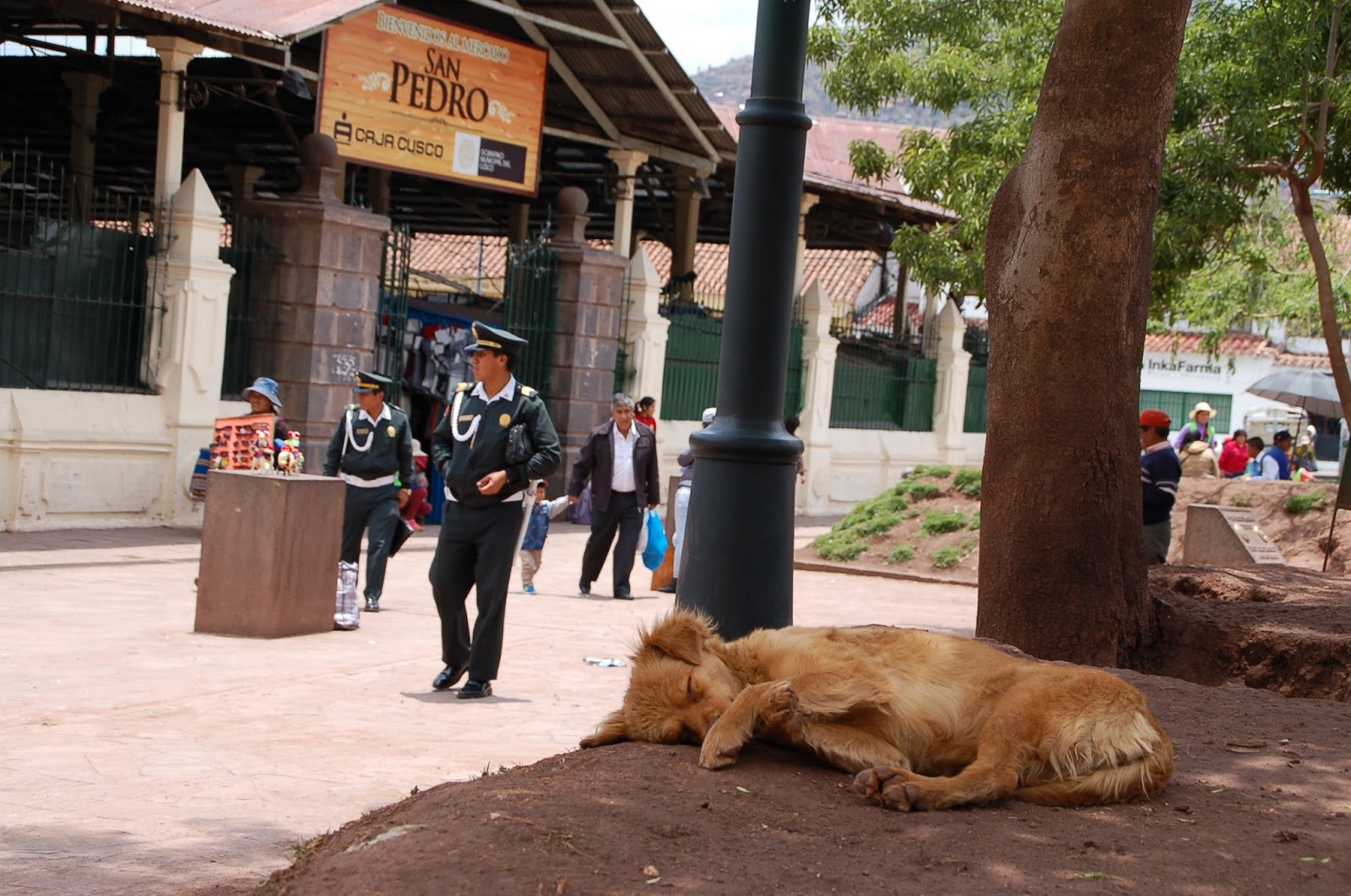
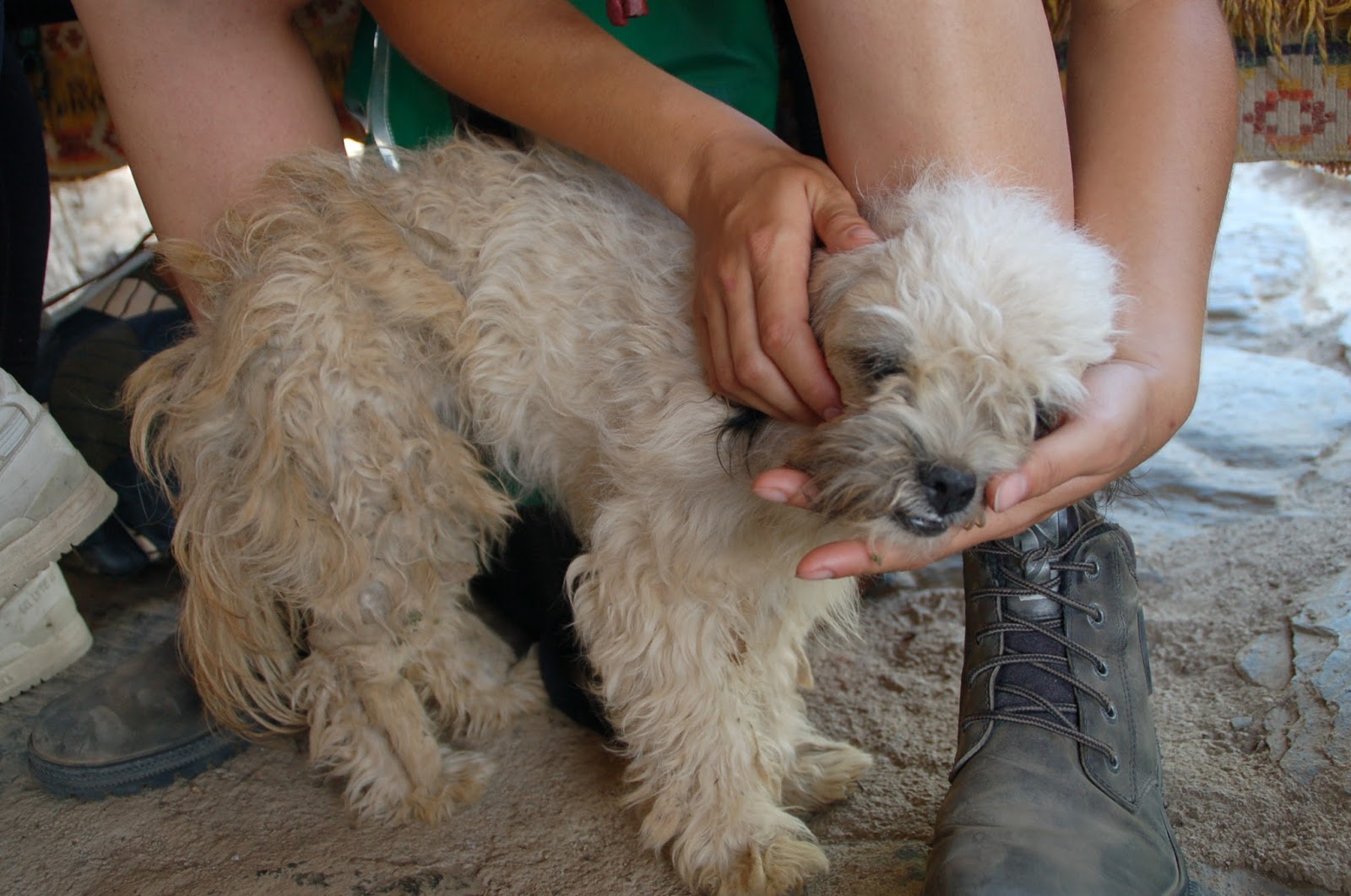
Dogs are everywhere.

Small dogs, big dogs, happy dogs, sad dogs, ratty dogs, bad dogs, young dogs, fun dogs, old dogs, hairy dogs, hairless dogs, toohless dogs, earless dogs, tailless dogs  and very often, ownerless dogs.

And a lama.

Market dog.

Lake Titicaca dog.

Corner shop dog.

Hike trail dog.


Village dog.

Machu Picchu dog.

And a lama.


29/11/2016

Cusco


Cusco is a UNESCO World Heritage Site and the "Historical Capital of Peru", hosting nearly two million visitors a year.

And it shows.

Tourism appears to concentrate on the Main Square, Plaza de Armas, the streets surrounding it, and the historical San Blas area situated on the hillside just above Plaza de Armas. I assume most of the city's 400,000 inhabitants can live their lives quite undisturbed by the tourist masses, as the city stretches far and wide with most buildings having just two or three floors.


However, my first Couchsurfing host lived right in the middle of San Blas, which I was excited about at the beginning, as it was supposed to be the best area to be in. And true, the narrow streets were very picturesque, and I loved the Quechuan street names and ancient white stone buildings that originate from the times before the Spanish conquerors had set their foot in the country.


If there only had been anything else left from times past. But no; this was a real tourist heaven. Or hell, depending on how you care to see it. Yoga, reiki, massages; hand-made scarfs, handicrafts, lama wool, alpaca; organised tours to do Machu Picchu, to do drugs with a shaman, to do paragliding or liquor tasting, to do a real Peruvian (I wouldn't be surprised); hostels with a bar, hostels with a view, hostels with oh-so-quaint colourful deco; vegan food vegan food VEGAN FOOD!!


Every place had a beautiful, hearty hippie name such as Mother Earth or Sister Moon or Universal Balance  or then "Inka" anything. In Spanish of course, to be cooler. And while I love yoga and vegan food and am fully aware of the complexity of foreigners travelling somewhere and demanding to get the really truly authentic experience (or, perhaps worse still, being horrified that a lot of other travellers want to see the same place as you), I could not take it.


It didn't make me sad because of the locals who were the owners of those businesses; I understand they have to earn their living and sell what people buy. (An important question, though, is whether those places are even owned by locals.) But it made me sad because of the vast masses of people who fly to Cusco and buy a reiki-shaman beer tour with a view and find it lovely. That's what I find so disturbing.


28/11/2016

Montaña Vieja

Wake-up at four; it's still dark. The narrow streets of the little town have a curious atmosphere: it's mostly silent and sleepy, but I pass several groups of other people, walking as briskly as I am in the still-cool air. The surrounding mountains have disappeared in the fog.

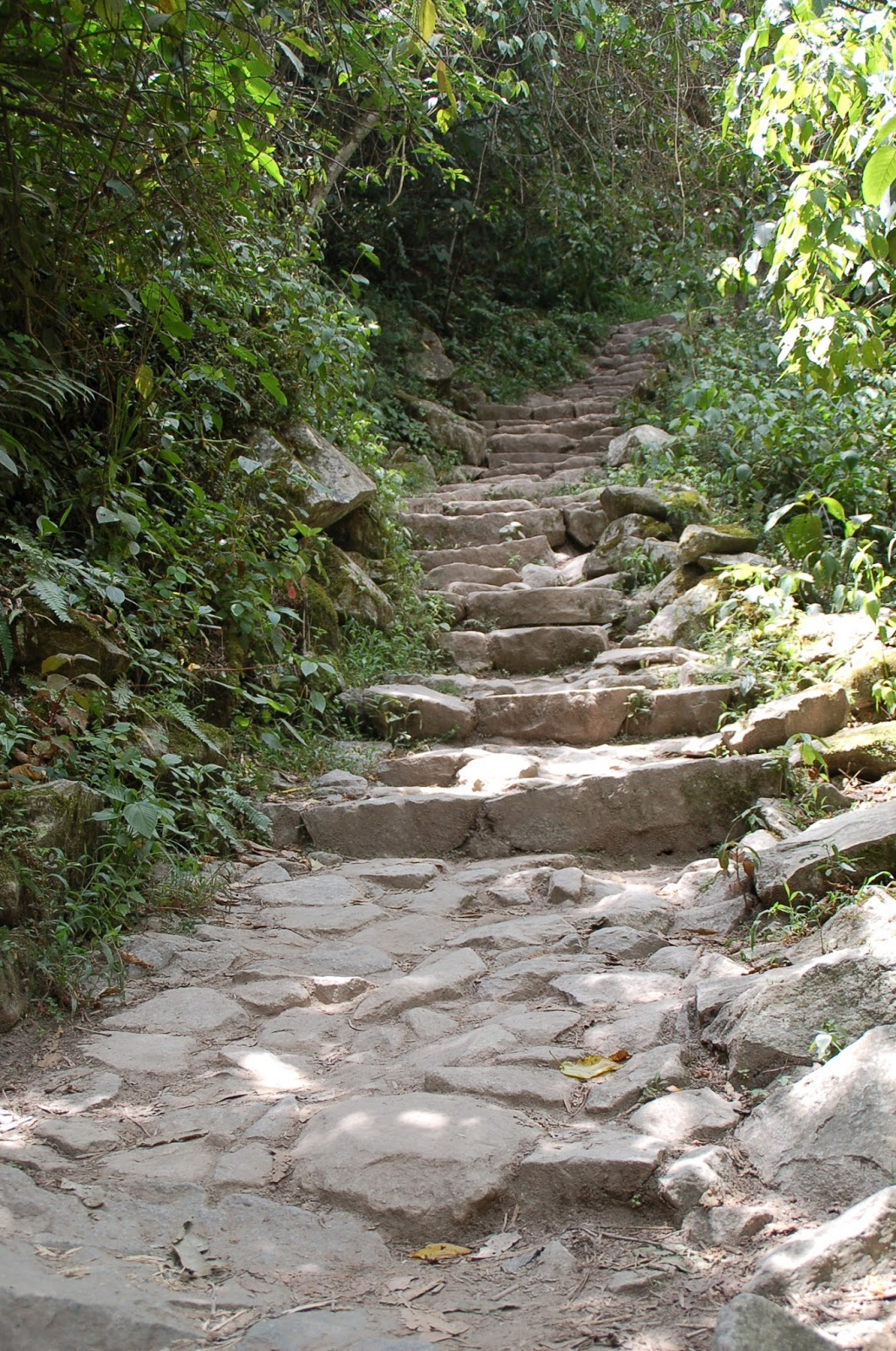
A half-hour walk to the starting point of the trail. And then: up, up, up the stone steps that have been laid in an ancient manner on the side of the mountain. These steps give no mercy to anyone, and when I pass people sitting down on some stones, most of them have the same look of astonishment and agony on their face: how much more?

There's always more. After every corner: still more. I don't know where I am  the trail is surrounded by trees, and even when there is a small open area, the fog around us makes everything in the distance invisible. It's as if walking in a tunnel.

But at the end of the tunnel, hidden by soaring mountains from all sides, hidden from everyone's view but the birds', is this.